Tether Has Frozen 9,141 Wallets on Tron. One in Ten Ever Gets Out.
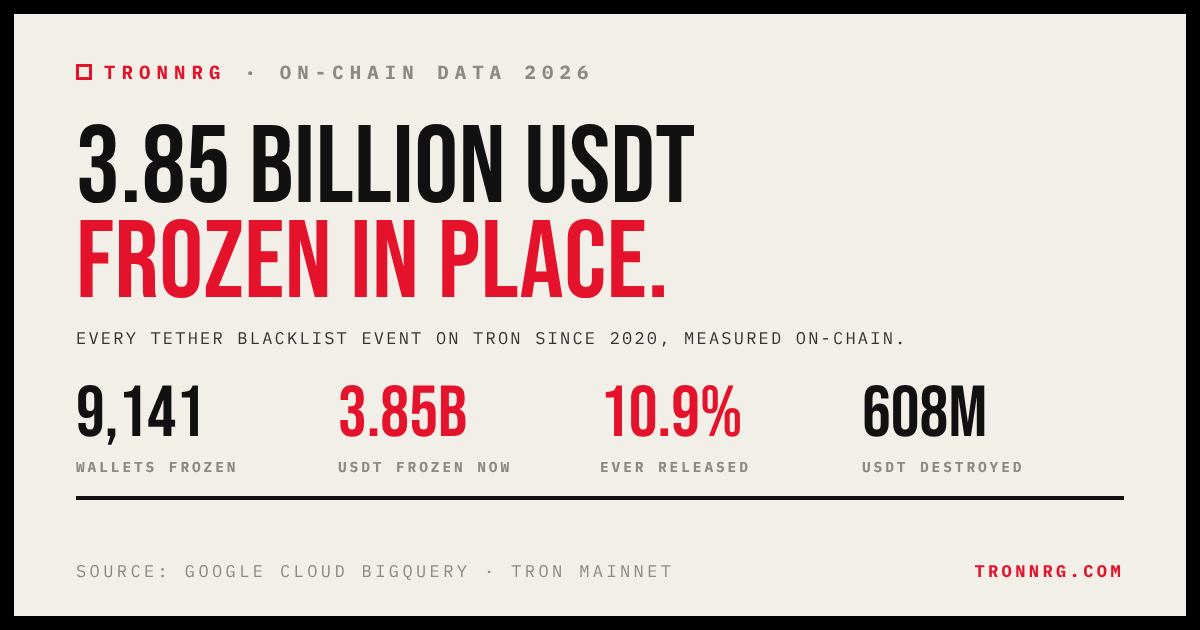
Everyone who holds USDT has wondered it at least once: how often does Tether actually freeze a wallet, and does it ever give the money back? Nobody had the full Tron answer, so I pulled it from the chain. Every blacklist event since the contract went live in 2020. 9,172 freezes. 3.85 billion USDT sitting in wallets that cannot move it. 608 million destroyed outright. And a release rate that explains why the fear is real, and why for almost everyone reading this it still does not apply.
Why I Went Looking
On the night of the Binance hack I sat and watched a transaction hit the USDT contract. Not a transfer. A call to the blacklist. In one block, 312 million USDT in the attacker's main Tron wallet became unspendable. I wrote about that night here.
What stayed with me afterwards was not the freeze. It was the question I got asked a dozen times before sunrise. Can they do that to me?
I have been giving the same answer for years. Technically yes, practically almost never. I believed it. But I had never checked it. Nobody had, not for Tron, not from the chain itself, not across the whole life of the contract. The numbers that circulate are from trackers that started counting late, or from Tether's own press releases, which only cover the cases Tether wants to talk about.
The contract keeps the real record. Every time Tether freezes an address it emits an event. Every time it releases one, another event. Every time it destroys the funds, a third. Those events cannot be edited, cannot be deleted, and have been accumulating since the first one in June 2020. So I pulled all of them.
Here is what six years of freezing actually looks like. Some of it I expected. The first row, I did not.
The Finding
Nine thousand wallets in six years. For scale, in the 90 days we studied for the sender concentration post, 21 million distinct wallets sent USDT on Tron. The entire six-year blacklist is smaller than one in two thousand of a single quarter's senders.
And yet 3.85 billion dollars sits inside it. That is the shape of this story. Rare, and enormous when it happens.
The First Freeze Was Tether Itself
26 June 2020, 15:22:39 UTC. The first AddedBlackList event on Tron. I expected a scam wallet or an exchange hack. The address was TR7NHqjeKQxGTCi8q8ZY4pL8otSzgjLj6t.
That is the USDT contract. Tether blacklisted its own token.
It took me a minute. Then it made sense. When people send USDT to the wrong address, one of the most common wrong addresses is the contract itself. Copy the token's address instead of the recipient's, hit send, and the money lands somewhere nobody holds the keys to. By mid-2020, enough had accumulated there that Tether did something about it. Freeze the contract address so nothing can move, then call DestroyedBlackFunds to burn what was stuck. The first burn that afternoon took out 18,529 USDT. Four burns in June 2020 cleared 682,078.
It did the same again in November 2020, January 2021 and February 2021. Four of the earliest freeze events on Tron were Tether cleaning up after its own users' typos. Not enforcement. Housekeeping.
The blacklist is a tool, and the first thing Tether used it for was recovery, not punishment. That pattern holds through the record. Of the 608 million USDT destroyed since 2020, most of it was burned so that an equal amount could be reissued to whoever it was taken from. Destroying frozen funds is how Tether gives money back.
Six Years, Year by Year
For the first two years the blacklist barely existed. 14 freezes in 2020. 24 in 2021. Then it starts climbing, and from 2024 the curve goes near vertical.
| Year | Freezes | Releases | Burns | USDT destroyed |
|---|---|---|---|---|
| 2020 | 14 | 0 | 21 | 7.9M |
| 2021 | 24 | 2 | 18 | 3.0M |
| 2022 | 315 | 3 | 225 | 17.0M |
| 2023 | 275 | 17 | 27 | 5.3M |
| 2024 | 1,225 | 60 | 73 | 61.3M |
| 2025 | 3,509 | 210 | 455 | 267.7M |
| 2026 (to 2 Nov) | 3,817 | 698 | 451 | 245.8M |
2026 passed 2025's full-year total in October, with two months still to run. The release column tells its own story: 698 releases this year against 210 last year. Tether is freezing more, and it is also letting more go. Both sides of the machine are getting busier.
A few months stand out, and each has a reason.
- October 2022: 206 freezes, 201 burns, 1.1 million USDT destroyed. Two hundred wallets frozen and emptied in a month, for just over a million dollars combined. Small wallets, lots of them. That is what a scam recovery sweep looks like on-chain: many victims, modest amounts, funds clawed back and returned. Three weeks later, on 10 November 2022, a single wallet was frozen holding 46.4 million. That one was FTX week.
- July 2025: 1,069 freezes. The busiest month in the record, more than the whole of 2024 in thirty days. The public explanation never arrived in one place. The T3 Financial Crime Unit, the joint Tether, Tron and TRM Labs operation, was running at full scale, and the GENIUS Act was signed on 17 July. Whatever the mix, July 2025 is when the blacklist stopped being occasional and became industrial.
- March 2026: 754 freezes. The second-biggest month. No single public case explains it.
- May 2026: 459 releases, 291 freezes. The only month in six years when the number of wallets let out exceeded the number locked up. On 14 May, Tether released 497 addresses across Tron and Ethereum in two batches an hour apart. The most plausible reading, from a firm that handles freeze disputes, is a queue of completed cases processed in one go.
The Biggest Freezes
The freeze event does not say how much was in the wallet. To get that, I rebuilt each frozen address's USDT balance at the exact block it was frozen, from every Transfer in and out beforehand. The method checks out: the top row is the Binance attacker's first Tron wallet at 312,729,468 USDT, which matches TRM Labs' published figure to the dollar.
| Frozen (UTC) | Wallet | USDT at freeze | Context |
|---|---|---|---|
| 29 Oct 2026 21:09 | TG5iBM…vzsGi | 312.7M | Binance incident, first Tron wallet, 47 min after the drain |
| 23 Apr 2026 12:02 | TNiq9A…QZH81 | 212.9M | Largest single action ever: 344.2M across two wallets in the same second, at the request of US authorities |
| 23 Apr 2026 12:02 | TTiDLW…pjSr9 | 131.3M | |
| 14 Jul 2026 21:02 | TFQbqa…9wC7k | 85.5M | One of three wallets, 128.8M combined |
| 10 Feb 2026 02:38 | TXNYeY…dgVjx | 83.8M | |
| 12 Jun 2026 07:37 | TBzrPE…9Ak9W | 72.0M | |
| 29 Oct 2026 21:21 | TCzBTk…7Y62 | 66.0M | Binance incident, second Tron wallet |
| 15 Jul 2024 14:12 | TTr4ST…D8vUR | 55.1M | Two wallets, 105M, 30 seconds apart |
| 15 Jul 2024 14:11 | TGTsSX…BVGQu | 50.0M | |
| 10 Jan 2026 22:49 | TCtVtr…uC2Aa | 50.0M | Largest of eight wallets frozen in 15 seconds, 297M combined |
| 10 Nov 2022 14:11 | TYDzsY…iAtW6 | 46.4M | FTX collapse week |
Two things from this table that were not public before.
The January 2026 action was bigger than reported. Press coverage at the time, working from a tracker, said five wallets and 182 million. The chain shows eight wallets frozen between 22:49:45 and 22:50:00 UTC on 10 January, holding 297 million between them.
And the Binance freeze, the biggest single-wallet freeze in Tron's history, was not the biggest action. April 23 was. Two wallets, one second, 344 million. It got a day of headlines and then disappeared. The chain remembers it as the record.
What Gets Destroyed
Freezing is step one. For 1,270 of those wallets, there was a step two: Tether called DestroyedBlackFunds and the USDT ceased to exist. 607.9 million in total.
The biggest single burn was 29.6 million on 21 November 2024, from a wallet that had been frozen the previous July holding 28.3 million. Two details in that. Freeze to burn took four months, which is roughly what a legal process takes. And the balance went up after the freeze, from 28.3 to 29.6 million, because a blacklisted wallet can still receive. Somebody kept sending to it.
Burns cluster late. The biggest burn month on record is October 2025 at 73.3 million, followed by January 2026 at 61.2 million and August 2025 at 49.0 million. The burn curve lags the freeze curve by months, which is what you would expect if each burn is the end of a case that began with a freeze.
3.85 billion frozen, 608 million destroyed, and the destroyed portion is mostly money on its way back to someone. Tether does not profit from a burn; it reissues. Seen that way, the blacklist is less a wall and more a holding pen with two exits: release, or destroy-and-reissue. The question is how often either door opens.
One in Ten
Of 9,172 freezes, 997 were later reversed. 10.9 percent.
When a wallet does get released, the median wait is 49 days. The fastest in the record was the same day. The slowest was 1,057 days, just under three years.
So the honest answer to "does Tether give it back" is: usually not directly. About one in ten wallets is unfrozen. A further share, the 1,270 burns, has its funds destroyed and reissued elsewhere, typically to a victim or under a legal order. The rest, the large majority, simply stays frozen. 8,164 addresses are blacklisted as I write this, holding 3.85 billion between them, and most of them have been that way for a long time.
There is one more number in here I find striking. About 850 of those 8,164 blacklisted addresses have never held a single USDT. They were frozen before they ever received anything. Someone identified them as a destination worth blocking in advance.
What This Means for Your Wallet
I started this because people kept asking whether it could happen to them. Here is what six years of data says.
It can. The blacklist is in the contract, not in your wallet app. TronLink, Trust Wallet, a hardware wallet, an exchange account, it makes no difference. If the address is added, it cannot send USDT.
It almost never does. 9,141 addresses in six years. Tens of millions of wallets have sent USDT on Tron in that time. If you deal with people you know and check the ones you don't, you are not in this dataset.
If it does, the odds are not good and the clock is long. One in ten released, median seven weeks, some cases years. That is the reason to care about who you accept USDT from, more than any fear of Tether itself. Tether does not freeze random wallets. It freezes wallets that received money someone else is chasing. The defence is the same as it has always been: check the sender, keep records, separate your receiving addresses, and run the 60-second blacklist check on anything you are about to rely on.
And one thing worth sitting with. The same record that shows 3.85 billion locked up also shows 312 million of a thief's money stopped inside 47 minutes, and 608 million destroyed so it could go back to the people it was taken from. Every one of those actions is on the chain, timestamped to the second, for anyone to check. I just did. You can too.
Methodology
Data source: Google BigQuery public dataset bigquery-public-data.goog_blockchain_tron_mainnet_us, logs table, filtered to the USDT TRC-20 contract TR7NHqjeKQxGTCi8q8ZY4pL8otSzgjLj6t (hex 0xa614f803b6fd780986a42c78ec9c7f77e6ded13c). Data current to 2 November 2026, 11:37 UTC, the timestamp of the most recent freeze in the table.
Events counted: AddedBlackList(address) (topic 0x42e16015…819dc), RemovedBlackList(address) (0xd7e9ec6e…4470c) and DestroyedBlackFunds(address,uint256) (0x61e6e66b…698c6). The address is the last 20 bytes of the first indexed topic. The destroyed amount is the event data as a uint256 with six decimals.
Freezes vs actions: 9,179 AddedBlackList events, 9,172 unique (address, day) pairs, 9,141 unique addresses. Seven events are same-day duplicates on an address; a few addresses were frozen, released and frozen again. We report 9,172 actions and 9,141 wallets.
Currently frozen: an address is counted as frozen today if its most recent blacklist event is an AddedBlackList. 8,164 addresses qualify.
Balance at freeze and balance today: rebuilt from USDT Transfer events (in minus out) restricted to the frozen address set. For today's balance we also subtract DestroyedBlackFunds amounts, because a burn zeroes the balance without emitting a Transfer. Without that correction the frozen-now figure reads 4.45 billion; with it, 3.85 billion. Of 8,164 blacklisted addresses, 7,315 have ever touched USDT and 5,254 hold a positive balance today.
Release rate: for each freeze, the first subsequent RemovedBlackList on the same address, if any. 997 of 9,172 freezes (10.9%) have one. Median gap 49 days.
Independent check: BlockSec's 2025 blacklist report counted 3,506 Tron addresses frozen in 2025. This dataset gives 3,509. The Binance figures (312,729,468 and 65,990,000 USDT) match TRM Labs' published amounts exactly, and the base58 forms of the top two addresses match the labels published by Bitquery.
What this does not tell you: why any individual address was frozen. The chain records the action, not the reason. Where a public explanation exists we have cited it; where it does not, we have said so. Contexts in the biggest-freezes table are from Tether's own statements and contemporaneous reporting by CoinDesk, TRM Labs, BlockSec and others, linked below.
Sources: CoinDesk, 23 Apr 2026 · CoinDesk, 10 Nov 2022 · BlockSec 2025 blacklist report · TRM Labs on the Binance incident · crypto.news, Jan 2026 · Match Systems on the May 2026 release batch
The 60-second blacklist check →
Also read: Tron & USDT statistics 2026 · Is USDT safe to hold?
SENDING USDT TODAY?
Send 4 TRX, get Energy in your wallet within 3 seconds, then send your USDT for 4 TRX instead of 13. No sign-up, no wallet connection, nothing to approve.
RENT ENERGY