Binance Lost $6.3 Billion in Twenty Minutes. Your USDT on Tron Did Not Move.
At 20:22 UTC on October 29, a Binance hot wallet on Tron sent 612.7 million USDT to an address nobody at Binance controlled. Within the hour, 971 million USDT across the attacker's wallets could no longer be spent. The chain never went down. Energy kept being delegated. USDT kept settling in three seconds. This is what actually happened, why your self-custody wallet was never in the blast radius, and the one risk that did change for everyone.
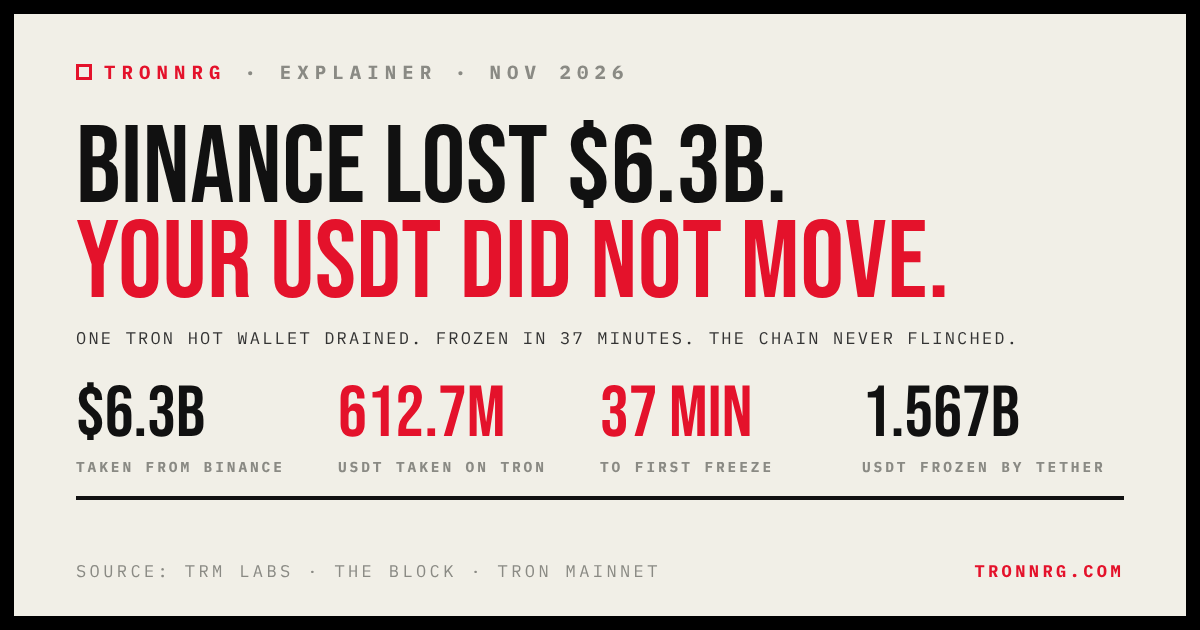
- On October 29, 2026, Binance lost about $6.3 billion from hot wallets across nine chains. On Tron: 612.7M USDT and 46.4M TRX.
- It was not a blockchain hack. Binance's own signing system was made to approve the withdrawals. Tron produced blocks normally the whole time.
- Tether froze 971.1M USDT within 37 minutes of the main sweep and over 1.567B USDT in total. Roughly $2.6 to $3 billion was frozen across all issuers.
- Self-custody wallets were never in the blast radius. The one risk that did change: stolen USDT is now moving through the ecosystem and can land in yours.
- Binance says users lose nothing. 90% replenished by October 31, withdrawals back on November 1.
The Night It Happened
I was sat at home, about to go to bed. One last look at the markets. The kind of look you do out of habit, not because you expect anything.
Then the chart moved. Not drifted. Moved. A candle that didn't belong to the rest of the day. I sat back down.
When a price does that with no news attached, something has happened that the news hasn't caught up with yet. So I went looking. A few searches, a few refreshes, and there it was. Suspicious outflows from Binance hot wallets. Billions, according to the first people counting. Then a Tronscan link. A Binance hot wallet on Tron had sent 612.7 million USDT to an address I'd never seen. Then 46.4 million TRX, same destination.
I did what I always do when something looks wrong on-chain. I refreshed. Nothing changed. The transaction was real, confirmed, and already a few minutes old.
At that point nobody knew it was Binance's biggest night. Nobody knew that the same thing had just happened on Ethereum, Bitcoin, XRP, Solana and four other networks inside the same twenty minutes. The market knew before the people did. It usually does.
Bed wasn't happening. I kept the page open. And over the next thirty-seven minutes I watched something happen that I think most people still haven't understood. I'll get to it. First, the part everyone gets wrong.
It Was Not the Blockchain
Within an hour the word "hack" was everywhere, and most people hearing it assumed a network had been broken. That is not what happened. Tron produced a block every three seconds through the whole night. Ethereum did its thing. Bitcoin did its thing. No contract was exploited. No private key was published.
What broke was inside Binance. The early account, from Binance itself, points to a compromised laptop belonging to a DevOps engineer. From there the attacker reached a service container and got Binance's own hot-wallet signing system to approve withdrawals it should never have approved. TRM Labs put it well: the attacker didn't steal the keys, they got the system that holds the keys to sign for them.
Here is a way to think about it. Your bank vault is fine. The steel is fine. Someone got hold of the manager's badge and walked money out through the front door while the cameras recorded everything. The vault did its job. The badge system didn't.
If the blockchain had been broken, every USDT holder on Tron would have a problem. It wasn't. The weakness was in one company's custody system. Anyone holding USDT in a wallet whose keys were never on a Binance server was, technically, a spectator.
And a spectator is a strange thing to be during a $6.3 billion theft. Because the money moving past you is very real, and some of it is about to start looking for a new home.
What Happened on Tron
The timeline below is pieced together from TRM Labs, The Block, Binance's own updates and what was visible on-chain. Times are UTC.
| Time (UTC, Oct 29) | What happened | Chain |
|---|---|---|
| 20:05 to 20:09 | Five Binance wallets send 233.46M XRP to one attacker address | XRP Ledger |
| 20:20 | 18,270 BTC leaves a Binance hot wallet; an Ethereum hot wallet is taken over via 50 pre-signed authorisations | Bitcoin, Ethereum |
| ~20:22 | 612.7M USDT and 46.4M TRX leave a Binance Tron hot wallet | Tron |
| ~20:24 | Ethereum hot wallet drained: 167,464 ETH and 63 tokens including 1.615B USDT | Ethereum |
| 21:01 | Tether freezes 971.1M USDT in the main receiving wallet, 37 minutes after the main sweep | Multi |
| 21:04 | Circle freezes 823M USDC | Ethereum |
| 21:27 to 01:00 | USDT0 pauses, then reopens, Tron to Ethereum USDT transfers as a precaution | Tron, Ethereum |
| 23:35 | Binance reports $2.54B verified frozen | All |
| Oct 31 | Binance reports 90% of losses replenished; withdrawals set for Nov 1 | All |
Tron's share of the theft was about $628 million. Big, but roughly a tenth of the total. Ethereum carried $3.79 billion. Bitcoin $1.47 billion. The attacker didn't single Tron out. They took whatever was in every hot wallet they could make the system sign for.
What happened next on Tron is the interesting part. Around 300 million of the stolen USDT was moved into a wallet that started interacting with JustLend, Tron's lending protocol. Every one of those moves was public the moment it happened. Analysts were labelling the wallets in real time, and that is exactly the kind of trail a blacklist can stop mid-stride.
The 46.4 million TRX is a different story, and it's worth being honest about it. TRX has no issuer. There is no one who can freeze it. That TRX is gone in a way the USDT isn't, and nothing on any chain changes that. It is the same reason Bitcoin's 18,270 BTC is gone. Permissionless money is permissionless in both directions.
The 37-Minute Freeze
So back to what I was watching instead of sleeping.
At 21:01 UTC, a transaction hit the USDT contract. Not a transfer. A call to a function most people never think about: the blacklist. In one block, 971.1 million USDT sitting in the attacker's main wallet became unspendable. Still there. Still visible. Still technically "theirs". But frozen in place, forever, unless Tether says otherwise.
Thirty-seven minutes after the sweep. On a Thursday evening in Europe. While Binance was still working out what was happening to itself.
Over the following hours Tether kept going. 378.7 million more in two attacker wallets on Tron. Smaller amounts as the attacker tried to hop. By the time Paolo Ardoino posted the total, Tether had frozen more than 1.567 billion USDT. Circle froze over 800 million USDC. Ripple froze the RLUSD. Even World Liberty froze its USD1. Combined, somewhere between $2.6 and $3 billion of stolen value was dead on arrival.
The feature that makes USDT the thing crypto purists complain about is the same feature that just clawed back a quarter of the biggest theft in the industry's history. A stablecoin is a claim on an issuer. That means the issuer can act. On the night of October 29, it did.
I have spent years on this network watching USDT move between people who have no bank, no card, and sometimes no passport. Freezes are the thing they worry about. And here was the freeze working the way it is supposed to: against a thief, fast, in public, with the receipts on Tronscan for anyone to check.
Which brings me to the question I got asked a dozen times before sunrise.
Can They Freeze Yours?
Yes. Technically, yes. The USDT contract on Tron has an owner-controlled blacklist. If your address is added, you cannot send USDT from it. You can still hold it, still receive it, still move your TRX and any other token. But the USDT is stuck.
Now the part that matters more than the yes. What actually triggers it.
- Hacks and thefts. This is what happened on October 29. Tether traces stolen funds and freezes the wallets holding them.
- Law-enforcement requests. Tether says it responds to valid requests from authorities. These are routine and almost never about ordinary users.
- Court orders and disputes. Rare, slow, and usually involving a specific commercial dispute.
- Tainted funds. This is the one to understand. If stolen USDT is traced through a chain of wallets and lands in yours, your address can be flagged even if you did nothing wrong.
For most readers of this blog, the first three will never apply. You have never been inside a Binance hot wallet. You are not under investigation. Nobody is suing you.
The fourth one, though. The fourth one just got more likely for everyone. And that is the real story of this week.
The One Risk That Changed
Roughly half of what was taken is frozen or recovered. The other half is not, and Binance, Tether, Chainalysis, TRM Labs and law enforcement are all tracing it. That tracing is the point. Every wallet the stolen funds touch gets labelled, and every label is a potential freeze.
Which is where you come in, even though you had nothing to do with any of it.
Let me be direct about what has and hasn't changed for you. Nothing about your wallet changed. Nothing about the network changed. Fees didn't change. Energy didn't change. The three-second settlement didn't change. If you sent USDT on Tron on October 29 at 20:30 UTC, it arrived, and it cost the same as it did at 20:00.
What changed is the number of flagged addresses in the ecosystem. For the next while there are more wallets on the watchlists, and an honest P2P desk, OTC broker or freelancer who accepts a payment from one of them can find their own address pulled into the net. Not because they did anything wrong. Because the trail passed through them.
That has always been true. It is just more true this month. So you do the thing you should have been doing anyway. You check.
The Checklist
CHECK THE SENDER BEFORE YOU ACCEPT
Paste the counterparty's address into Tronscan. Look for a risk label, a flagged tag, or a direct link to a labelled exchange hack wallet. Our address verification guide walks through it in a minute.
CHECK YOUR OWN WALLET
Run the 60-second blacklist check on every address you receive into. Free, instant, and you'll know for sure instead of wondering.
SEPARATE YOUR RECEIVING ADDRESSES
Unknown counterparties go to one wallet. Your savings sit in another. If a freeze ever lands, it lands on a small balance, not your life.
ASK FOR A TEST TRANSFER
A few USDT first. It costs almost nothing with Energy loaded, and it shows you the sending address before the real amount arrives.
KEEP RECORDS
Trade screenshots, invoices, chat logs. If you are ever asked to explain where funds came from, the person with records wins.
DON'T CONFUSE AN EXCHANGE BALANCE WITH A WALLET
Binance did the right thing and covered its users. Not every exchange could. Keep trading float on the exchange, settlement float in a wallet you hold the keys to, and load Energy before you move between them so each hop costs 4 TRX instead of 13.
The Quiet Part
Something happened on Tron that night that nobody wrote a headline about.
The network didn't flinch. Not in the sense of "it survived". In the sense that it did not notice. Blocks every three seconds. Energy delegations landing in wallets. USDT transfers from people in Lagos and Manila and Karachi who had no idea anything was happening, because for them nothing was. The ledger kept the score the whole time, including the score against the thief.
I think that is the thing worth sitting with. A $628 million theft passed through the Tron network and left behind a perfect, public, permanent record of itself. Every hop. Every wallet. Every attempt to park it in JustLend. Tether read that record and acted on it within the hour. Investigators are reading it now. In a year, people will still be reading it.
There is no version of the old system where that happens. A wire fraud of that size doesn't leave a trail anyone outside the banks can see. This one left a trail anyone with a browser can see.
Binance will come out of this fine, and credit to them for how they handled it. Users made whole, withdrawals back inside three days, transparency about the cause even when the cause was embarrassing. That is how you want an exchange to behave when the worst happens.
But the lesson I'm taking isn't about Binance. It's that the chain did its job, the issuer did its job, and the only thing left for you to do is yours. Check who you're receiving from. Keep your keys. Load your Energy. Send.
Ping. Still here.
Also read: Is USDT safe to hold? · What is Tron Energy?
MOVING USDT OFF AN EXCHANGE THIS WEEK?
Send 4 TRX, get Energy in your wallet within 3 seconds, then send your USDT for 4 TRX instead of 13. No sign-up, no wallet connection, nothing to approve.
RENT ENERGY